
5 Steps to Take When Your AC Breaks Down During a Florida Heat Wave
In most parts of the country, a broken air conditioner is an inconvenience. In St. Petersburg, Florida in the middle of summer, it's a health situation. When temperatures push past 90°F and humidity climbs into the 80s, a home without cooling can become dangerous within hours — especially for children, elderly residents, and pets.
If your AC just stopped working, you're probably looking for answers fast. This guide walks you through exactly what to check before you call, what to do while you wait for a tech, and how to decide whether repair or replacement makes more sense. GoodWind offers same-day AC repair in St. Petersburg and throughout Pinellas County — so if you've already run through these steps, call us at 727-557-9517
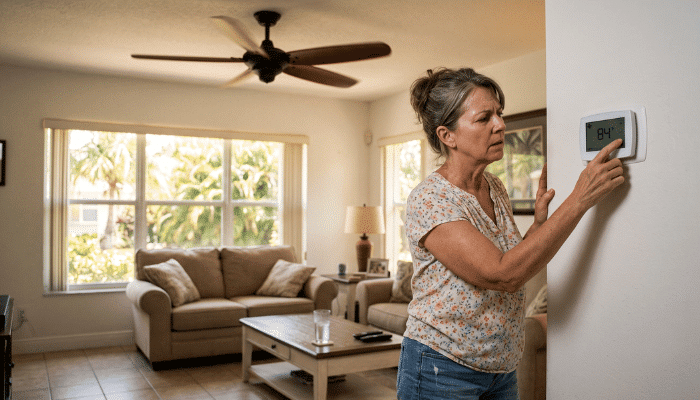
Step 1: Turn the System Off at the Thermostat
The instinct is to crank the thermostat lower and wait for the house to cool down. Resist it. If your system is malfunctioning — whether it's a frozen coil, a tripped safety switch, or an electrical fault — running it continuously can cause additional damage to components like the compressor.
Set your thermostat to OFF, not just to a higher temperature. Give the system 30 minutes to sit before you try anything else. This allows a frozen evaporator coil to thaw and pressure to equalize, which matters for the diagnostic steps that follow.
Step 2: Check These Four Things Before You Call
There are a handful of simple, safe checks any homeowner can do that sometimes resolve a shutdown without a service call. Work through these in order.
Your circuit breaker. Go to your electrical panel and look for a breaker labeled "AC," "Air Handler," or "Condenser." A tripped breaker will be in the middle position — not fully on, not fully off. Reset it by pushing it firmly to OFF first, then back to ON. If it trips again within a few minutes, stop. A breaker that keeps tripping signals an electrical fault that needs a licensed technician, not a homeowner reset.
Your air filter. A filter that's been in place for three or four months in a Florida home — especially a coastal one with extra airborne particles — can get clogged enough to starve the system of airflow. When airflow drops too low, the evaporator coil freezes, the system shuts down on a safety switch, and it won't restart until it thaws. Pull the filter, hold it up to light, and replace it if you can't see through it. Then wait an hour before restarting.
Your condensate drain line. This is the most common Florida-specific culprit. High humidity means your air handler produces a lot of condensation, and those drain lines clog with algae and debris regularly. When the drain pan fills up, a float safety switch cuts power to the system automatically. Locate the drain pan beneath your air handler — if there's standing water in it, that's your problem. Many homeowners clear minor clogs by pouring a small amount of water into the drain access port to check flow. If it's backed up, a technician can flush it quickly.
Your outdoor unit. Go outside and look at the condenser unit. Is it running at all — fan spinning, unit humming? If it's completely silent while the system is set to cool, that suggests a power or capacitor issue. If it's running but the air coming from your vents is warm, the refrigerant charge may be the problem. Either way, that's a service call.
Step 3: Stay Safe While You Wait
If the system isn't cooling and you're waiting on a technician, your priority is keeping the household safe — not the house comfortable.
Close blinds and curtains on south- and west-facing windows. Direct sun through glass adds heat load fast. Turn on ceiling fans — they don't cool the air, but they make it feel cooler on your skin, which buys time. Move to the lowest floor if you have one, since hot air rises. Fill a cooler with ice and water, especially if you have children, elderly family members, or pets in the home. Avoid using the oven or any large appliances that generate heat. And if the indoor temperature climbs above 90°F, strongly consider relocating to a neighbor's home, a library, a mall, or any air-conditioned space until your system is restored.
Step 4: Know What to Tell the Technician
When you call for service, the more clearly you can describe what happened, the faster the diagnostic goes. Be ready to share:
- When the problem started and whether it happened suddenly or gradually
- Whether the outdoor unit is running, making unusual sounds, or completely off
- Whether any air is coming through the vents, and if it's warm or cold
- Whether your circuit breaker tripped, and whether you reset it
- The approximate age of your system and the last time it was serviced
GoodWind's technicians can often narrow down the likely cause before they arrive, which means they come prepared with the right parts rather than having to make a second trip.
Step 5: Repair or Replace? How to Decide Quickly
Once a technician has diagnosed the problem, you'll need to make a decision. A useful rule of thumb: if the repair cost is more than half the cost of a new system, and your current unit is 10 years or older, replacement usually makes better financial sense in the long run.
Florida systems work harder and wear out faster than in most climates — year-round operation in high heat and humidity accelerates wear on components like compressors, capacitors, and coils. A 12-year-old system that needs a compressor replacement is likely to need the next thing within a year or two.
If the cost conversation steers you toward replacement, GoodWind offers flexible financing options through KwikComfort and Mitsubishi Electric that can spread the cost over manageable monthly payments. You can also explore AC replacement options — including high-efficiency systems that lower monthly energy bills enough to offset the upgrade cost over time.
If your home has rooms without existing ductwork, or you're dealing with persistent hot spots, a ductless mini-split system may solve both the immediate problem and a longer-term comfort issue at the same time.
The Best Way to Avoid This Next Summer
An emergency breakdown in peak heat is stressful and expensive. The single most effective way to prevent it is a professional tune-up before the brutal June–September stretch begins — ideally in spring, before every HVAC company in Pinellas County is fully booked.
GoodWind's residential maintenance plan includes seasonal tune-ups, priority scheduling when you do need service, and discounts on repairs. Members consistently avoid the worst summer breakdowns because small problems — low refrigerant, a failing capacitor, a dirty coil — get caught and corrected before they become emergency calls.
Regular AC maintenance also extends the useful life of your system, which matters when a full replacement runs several thousand dollars.
GoodWind Is Available Now — Same Day or Next Day
If your AC is down today and you need a reliable, licensed technician in the St. Petersburg area, call GoodWind Cooling & Heating at 727-557-9517 . We offer same-day and next-day service throughout St. Petersburg, Clearwater, Largo, Seminole, St. Pete Beach, Gulfport, and the surrounding Pinellas County communities. Se Habla Español.
Schedule service online or call us now — we'll get your home comfortable again.