
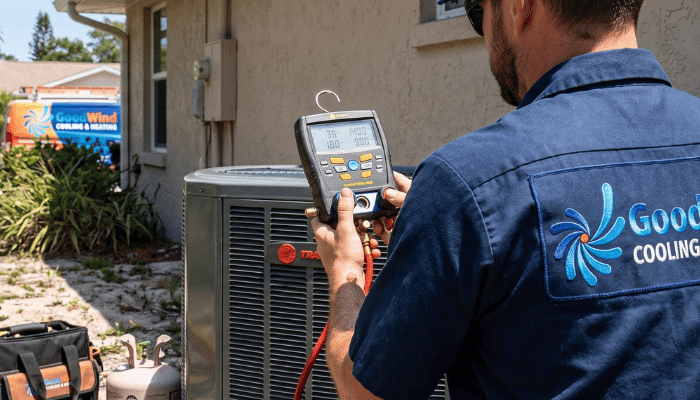
If you've called an HVAC company recently or started shopping for a new AC system, you've probably heard something about a refrigerant change. The contractor used words like "R-454B," "AIM Act," or "A2L," and you walked away with more questions than answers.
You're not alone — and the confusion is understandable. The headlines about R-410A being "phased out" or "banned" have been alarming, and some of them have been misleading. This post explains what actually changed, what it means for Florida homeowners with existing R-410A systems, and what you need to know if you're considering a new AC installation in 2026.
What Is R-410A?
R-410A is the refrigerant that has been used in the vast majority of residential and light commercial air conditioners sold in the United States since the mid-1990s. It replaced R-22 (Freon), which was phased out due to its ozone-depleting properties.
R-410A works well as a refrigerant — it doesn't deplete the ozone layer — but it has a very high global warming potential (GWP) of 2,088, meaning it traps 2,088 times more heat in the atmosphere than carbon dioxide when it leaks or is vented. That environmental impact put it in the crosshairs of federal regulators.
What Changed, and When
In December 2020, Congress passed the American Innovation and Manufacturing (AIM) Act, which gave the EPA authority to phase down U.S. production and consumption of high-GWP refrigerants — including R-410A — by 85% by 2036. The EPA then established specific rules about what equipment manufacturers can build and sell.
The key date for homeowners is January 1, 2025: as of that date, manufacturers can no longer produce or import new residential split-system air conditioners or heat pumps that use R-410A. Every major brand — Carrier, Trane, Goodman, Lennox, Mitsubishi, Daikin — has already retooled its production lines around the new-generation refrigerants.
The EPA's AIM Act regulations also originally set a January 1, 2026 deadline for installing R-410A systems manufactured before 2025, but the EPA deprioritized enforcement of that installation deadline and has since issued an amended rule (effective July 27, 2026) allowing installation of pre-2025 R-410A inventory until those existing supplies are depleted.
What This Does NOT Mean
This is where a lot of homeowners — and some contractors — get confused. Here's what the R-410A phase-out does not mean:
Your existing system is not illegal. Every R-410A air conditioner or heat pump already installed in a U.S. home is fully grandfathered. There is no regulation requiring you to replace, retrofit, or remove it.
R-410A is not banned for service use. The refrigerant itself remains legal to use for recharging and servicing existing systems indefinitely. A licensed technician — like GoodWind's team — can still add refrigerant to your system, repair leaks, and perform any other service it needs. The phase-out applies to new equipment manufacturing, not to the service and maintenance of systems already in homes.
You don't have to do anything right now. If your R-410A system is running well, there's no immediate action required. Continue scheduling regular AC maintenance to maximize its lifespan, and make replacement decisions based on system age and performance — not regulatory panic.
How This Is Already Affecting Repair Costs
Here's the part that does warrant attention: R-410A service refrigerant is getting more expensive, and that trend will continue.
Because no new R-410A is being manufactured for equipment, technicians must source it from reclaimed and recycled supplies — a finite and shrinking pool. Industry data confirms that R-410A refrigerant cylinder prices increased significantly through 2025 and into 2026 as supply chains adjusted to the transition. This is following the same trajectory as the R-22 phase-out, where service refrigerant prices climbed hundreds of percent over a decade before the systems that used it were retired.
What this means practically: if your R-410A system develops a refrigerant leak — whether from a worn valve, a damaged coil, or a line set issue — the cost of recharging it will be higher than it was two or three years ago. And it will continue rising. For minor leaks on a relatively new system, AC repair still makes clear financial sense. But for an older system with a significant refrigerant-involved failure, the math starts to shift toward replacement.
What's Replacing R-410A
New AC systems manufactured in 2025 and beyond use A2L refrigerants — a category defined by low global warming potential and mild flammability. The two you'll encounter most often:
R-454B (sold under the brand name Puron Advance) is the primary replacement for ducted central air conditioning systems. It carries a GWP of 466 — less than a quarter of R-410A's environmental impact. Most major manufacturers have standardized on R-454B for split-system central AC.
R-32 is commonly used in ductless mini-split systems, including many Mitsubishi Electric models. It has a GWP of 675 and has been widely used in Europe and Asia for years. If you're considering a ductless mini-split installation, your new system will very likely use R-32.
Both refrigerants are classified as A2L — mildly flammable. This classification sounds alarming, but in practice it means they require updated handling protocols and specific compatible components. All new equipment is engineered and certified with these requirements built in. When installed by a trained, licensed technician, A2L systems are safe.
It's worth noting: you cannot convert an existing R-410A system to use R-454B or R-32. The refrigerants are not drop-in replacements. New refrigerant requires new equipment. Any contractor suggesting a retrofit conversion should be a red flag.
For a manufacturer-level overview of the transition, Trane's refrigerant resource page offers a straightforward breakdown of what changed and why.
Should You Replace Your System Now?
Whether it's time to replace your R-410A system depends on several factors — and the refrigerant change alone is not a reason to rush.
Replace sooner if:
- Your system is 10 to 12 years old or older
- You've had two or more significant repairs in the past two years
- Your energy bills are noticeably higher than they used to be (a sign of declining efficiency)
- A recent repair involved refrigerant and cost more than you expected
- A technician has flagged an impending compressor or coil failure
Continue servicing if:
- Your system is relatively young (under 8 years)
- It's been well-maintained and running efficiently
- Any needed repairs don't involve major refrigerant work
- The repair cost is well below 40–50% of a replacement quote
If you're in the middle zone — a system that's 8 to 12 years old, holding up but not perfectly — this is a smart time to get an honest evaluation. GoodWind's technicians can assess the remaining useful life of your current system and give you a clear picture of what repair costs are likely to look like over the next few years, versus what a new R-454B or mini-split system would cost and save. There's no pressure to replace anything that doesn't need replacing.
For homeowners who are ready to upgrade, flexible financing through KwikComfort and Mitsubishi Electric makes it possible to move forward without the full upfront cost. New high-efficiency systems also tend to lower monthly energy bills meaningfully in Florida's climate — additional savings the U.S. Department of Energy notes are especially significant in warm-weather states where systems run year-round.
Talk to GoodWind — No Pressure, Honest Answers
Whether you're trying to understand what your last repair estimate actually means, wondering if your system is worth keeping, or ready to explore AC replacement options, GoodWind Cooling & Heating gives you straight answers — not upsells.
We service all R-410A systems throughout St. Petersburg, Clearwater, Largo, Seminole, St. Pete Beach, and the surrounding Pinellas County area. And if it does make sense to move to a new system, we can walk you through the options that fit your home, your budget, and your comfort goals. Se Habla Español.
Schedule a service call or consultation online — or call us directly at 727-557-9517
No. The EPA's AIM Act prohibits manufacturing new AC equipment with R-410A, but the refrigerant itself remains legal to use for servicing existing systems. Your R-410A system can still be repaired and recharged.
No. Existing systems are fully grandfathered. Replace when it makes financial sense based on age, performance, and repair costs — not because of the regulatory change.
R-454B for most ducted central AC systems; R-32 for most ductless mini-splits. Both are A2L refrigerants with significantly lower environmental impact than R-410A.
For repairs involving refrigerant, yes — gradually, as recycled R-410A supplies shrink. Preventive maintenance is the best way to avoid refrigerant-related failures on an existing system.
No. R-454B and R-32 require new equipment with compatible components. There is no retrofit path.