
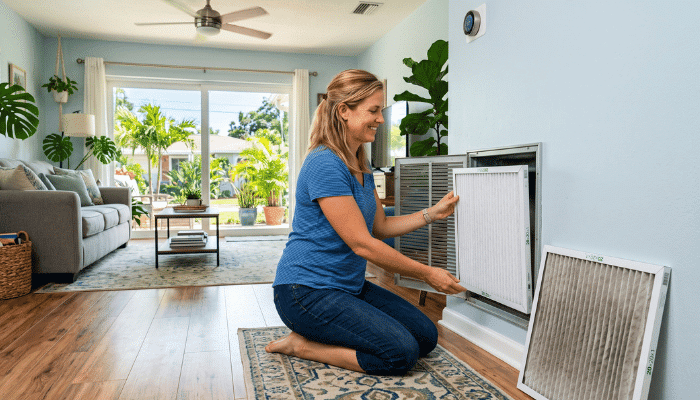
Quick answer: In most Florida homes, a standard 1-inch air filter should be changed every 30 to 60 days — closer to every 30 days during peak summer or if you have pets or allergies. Thicker 4- to 5-inch media filters typically last 6 to 12 months. Because HVAC systems here run nearly year-round, filters clog faster than they do in cooler climates, so the "every 90 days" rule you see on the package is often too long for St. Petersburg.
It's the smallest, cheapest piece of HVAC maintenance you can do — and one of the most overlooked. A clean filter protects your energy bill, your air quality, and the lifespan of your system. Here's how to get the timing right for our climate.
Why Filter Changes Matter More in Florida
Up north, an HVAC system might sit idle for weeks in spring and fall. Here in Pinellas County, it almost never gets a break — which means your filter is working overtime all year.
- Year-round runtime. Our long cooling season means your system runs nearly every day, pulling air (and dust) through that filter constantly.
- Humidity. Florida's moisture can dampen a clogged filter, creating the perfect conditions for mold and mildew to take hold inside your system.
- Pollen and coastal dust. Seasonal pollen and fine, salty coastal air add to the load, especially near the water in places like St. Pete Beach and Indian Rocks Beach.
Add it up, and a filter that "should" last three months often needs changing in one. That's why the same first-of-the-season dust that causes a burning smell when you first run the heat builds up so quickly here — your filter is the front line against it.
How Often to Change It, By Filter Type
Not all filters are the same. Match your schedule to what's actually in your system:
Then adjust shorter if you have:
- Pets — fur and dander clog filters fast; check monthly
- Allergies or asthma in the household
- Heavy summer use with the system running constantly
- A coastal home with more airborne salt and dust
- Recent renovation or construction dust
When in doubt, pull the filter and hold it up to the light. If you can't see light through it, it's time — regardless of the calendar.
What Happens If You Don't Change It
A clogged filter doesn't just sit there — it actively costs you money and comfort:
- Higher energy bills. A dirty filter restricts airflow, forcing your system to work harder and run longer to hit the same temperature. It's one of the ways a neglected system quietly raises your energy bills.
- Weak or uneven airflow. Some rooms never seem to cool down.
- Frozen coils. Restricted airflow can cause the evaporator coil to freeze over, shutting the system down entirely — a common Florida service call.
- Worse indoor air quality. A saturated filter stops trapping dust, dander, and allergens, which then recirculate through your home. Our indoor air quality services can help if this is already an issue.
- Shortened system life. The added strain wears out components faster and can even affect your manufacturer's warranty.
Staying on top of filters is one of the simplest pieces of AC maintenance — and it pays for itself quickly.
Which Filter Should You Buy? (A Quick MERV Guide)
Filters are rated by MERV (Minimum Efficiency Reporting Value) — the higher the number, the smaller the particles it traps. But higher isn't always better: a filter that's too dense can restrict airflow and strain your system.
For most Florida homes, MERV 8 to 11 is the sweet spot — good filtration without choking airflow. Homes with allergy concerns may go slightly higher, but check that your system can handle it before jumping to a hospital-grade filter.
Not sure what your system can take? That's a great question to ask during a maintenance visit — the right filter for your equipment beats the most expensive one on the shelf.
How to Change Your Air Filter (in Under 5 Minutes)
- Turn off your system at the thermostat.
- Locate the filter — usually in a return-air vent (wall or ceiling) or in a slot near the air handler.
- Note the size printed on the frame (e.g., 16x25x1) and the airflow arrow direction.
- Slide out the old filter and slide in the new one, arrow pointing toward the unit/ductwork.
- Turn the system back on — and jot the date on the new filter's frame so you remember next time.
Don't Want to Track It? Let Us Handle the Reminders
If remembering filter changes (and everything else your system needs) feels like one more thing on the list, that's exactly what a maintenance plan is for. With an HVAC maintenance plan, we keep your system clean, tuned, and running efficiently — and remind you when it's time for service so nothing slips.
For most homes, every 30 to 60 days for a standard 1-inch filter — closer to every 30 days in peak summer or with pets or allergies. Thicker 4- to 5-inch media filters usually last 6 to 12 months. Because HVAC systems run nearly year-round in Florida, filters clog faster than the packaging's "90-day" estimate suggests.
MERV 8 to 11 is ideal for most homes — strong filtration without restricting airflow. Go higher only if you have specific allergy needs and your system can handle the denser filter.
Yes. A clogged filter restricts airflow, forcing your system to run longer and work harder to reach the set temperature, which uses more energy and drives up your bill.
It can. Restricted airflow from a dirty filter is one of the most common causes of a frozen evaporator coil, which can shut the whole system down until it thaws and is serviced.
Check the size printed on the frame of your current filter (for example, 16x25x1). If it's missing, measure the length, width, and thickness of the filter slot, or ask your technician during a service visit.