
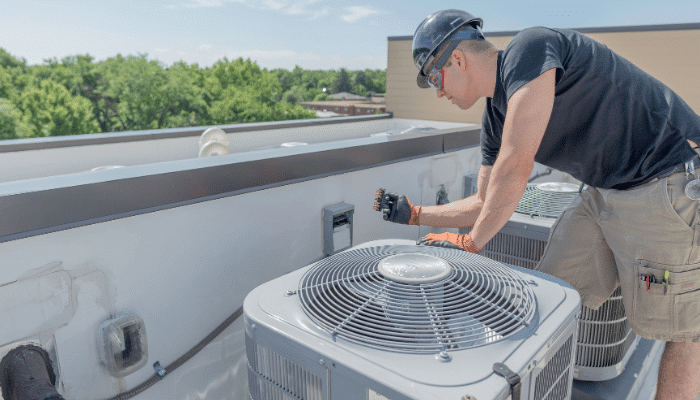
Most commercial HVAC systems should be professionally serviced at least twice a year — once before cooling season and once before heating season. High-use businesses like restaurants, medical offices, gyms, and retail often need quarterly service, plus monthly filter checks. In Florida, where systems run nearly year-round, more frequent maintenance is the best way to prevent breakdowns, control energy costs, and extend equipment life.
For a business, a failed HVAC system isn't just uncomfortable — it's lost revenue. Customers leave, employees can't work, inventory can be at risk, and an emergency repair almost always costs more than the maintenance that would have prevented it. The good news is that most commercial breakdowns are avoidable with the right service schedule. Here's how often your commercial HVAC system should be serviced in Florida, and what goes into keeping it running.
How Often Should Commercial HVAC Be Serviced?
As a baseline, every commercial system should be professionally serviced at least twice a year — a spring visit to prep for the long cooling season and a fall visit before you rely on heat. But many Florida businesses need more:
- Quarterly (every 3 months) for high-demand environments — restaurants and kitchens, medical and dental offices, gyms, salons, and busy retail.
- Monthly filter checks for spaces with heavy foot traffic, cooking exhaust, or air-quality requirements.
- Year-round attention for rooftop units (RTUs), which take a beating from Florida sun, rain, and salt air.
If it's been more than a year since your last professional service, that's the sign to schedule now.
What Affects Your Maintenance Schedule?
The right frequency depends on your building and how you use it:
- System type & age — rooftop units and older equipment need closer attention than newer split systems.
- Business type & occupancy — more people, cooking, or equipment means more strain and faster filter loading.
- Indoor air quality needs — medical, dental, and food-service spaces have higher standards.
- Manufacturer & warranty requirements — many commercial warranties require documented routine maintenance to stay valid.
- Runtime — in Florida, systems rarely get a break, so wear adds up faster than in cooler climates.
What's Included in Commercial HVAC Maintenance?
A thorough commercial maintenance visit typically covers:
- Inspecting and cleaning coils, blowers, and drain lines
- Checking and replacing filters
- Testing refrigerant levels and looking for leaks
- Inspecting electrical connections, contactors, and capacitors
- Checking belts, motors, and moving parts
- Verifying thermostat and control operation
- Confirming safe, efficient performance across every unit
The Real Cost of Skipping Maintenance
Deferring service doesn't save money — it moves the cost to a worse time:
- Downtime & lost business when a unit fails during peak hours or peak season
- Higher energy bills as dirty coils and clogged filters make the system work harder
- Shortened equipment life and earlier, more expensive replacement
- Voided warranties when required maintenance isn't documented
Why Florida Businesses Need It Even More
Our climate is uniquely tough on commercial equipment. Systems run almost every day of the year, high humidity encourages mold and drain-line clogs, and coastal salt air corrodes outdoor and rooftop units. That combination means Florida businesses that stick to a consistent maintenance schedule see fewer surprise breakdowns and lower operating costs than those that wait for something to go wrong.
Make It Effortless With a Commercial Maintenance Plan
The simplest way to stay on schedule is to let someone else track it. GoodWind Cooling & Heating is a family-owned HVAC company serving St. Petersburg and Pinellas County, and our commercial maintenance keeps your system inspected, tuned, and ready — so you can focus on running your business instead of worrying about the AC.